The house, room by room
Inside Frida Kahlo's Casa Azul
A room-by-room guide to the Casa Azul in Coyoacán: the courtyard, the kitchen, the studio, the bedrooms, the garden pyramid and how the house became a museum.
Choose a time at the Casa Azul ↗Quick answer
The Casa Azul is the house in Coyoacán where Frida Kahlo grew up, lived with Diego Rivera and died in 1954. Inside you walk through a courtyard, rooms of letters, dresses and ex-votos, a yellow-tiled kitchen, a dining room, her studio and bedrooms in a 1940s stone wing, and a garden with a stepped pyramid. It has been a museum since 1958, kept close to how the couple left it.
A family house from 1904
The house was built in 1904 in Colonia del Carmen, Coyoacán, on the corner of what are now Londres and Allende streets. It first had French-style decoration, and its plainer front came later. Frida Kahlo's parents were the photographer Guillermo Kahlo, a German immigrant, and Matilde Calderón y González. She grew up here and spent most of her life in the house; she said she was born in it, although the civil register records the nearby home of her maternal grandmother. In 1913, during the Revolution, her mother reportedly opened the windows to pass supplies to Zapata's army. Today the walls are painted the deep blue that gives the house its name, with red-oxide trim and green window bars.
The courtyard and the inscription
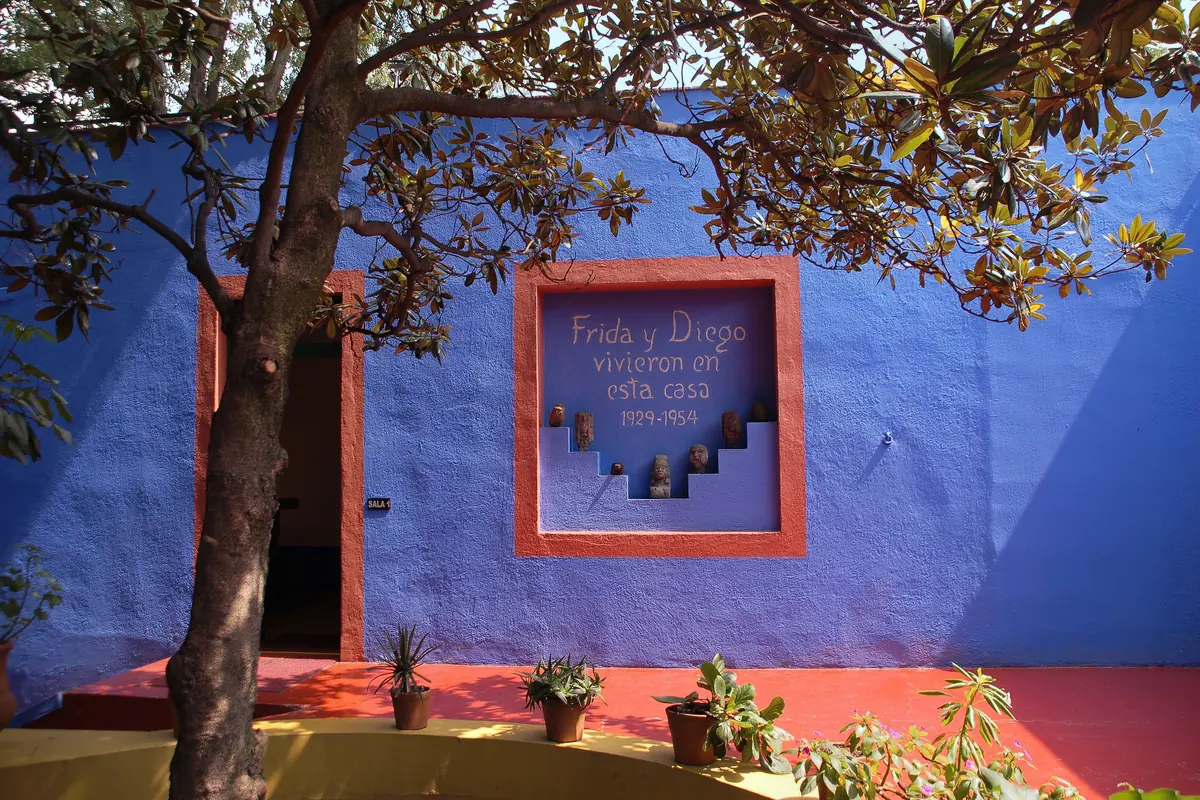
You enter from Londres Street into the courtyard, the heart of the house. Blue walls frame it on several sides, plants crowd the beds and pots, and shells and mirrors are set into some of the walls. On one wall, in a red frame above small stone figures set in stepped niches, an inscription reads 'Frida y Diego vivieron en esta casa 1929–1954', Frida and Diego lived in this house. Take your time here: the museum lets you photograph freely in the courtyards and garden, while inside the rooms only phone photos without flash are allowed. From the courtyard you can see how the later stone wing closes the space.
Rooms of objects
The first rooms are about the life rather than the work. They hold personal objects: photographs, letters, Tehuana-style dresses, toys and jewellery, which show Kahlo as a collector as much as a painter. The couple gathered hundreds of ex-votos, small votive paintings, and many hang along the stairwell. Other rooms show folk art, paintings from the 16th to the 19th centuries, works by Paul Klee and José María Velasco, two large Judas figures and pre-Hispanic pieces. A permanent display set up at the end of the 1960s includes some of Kahlo's own works, among them her first self-portrait and Viva la Vida. Displays change, so the exact selection depends on the day.
- Photographs and letters
- Tehuana-style dresses and jewellery
- Ex-votos collected by the couple
- Folk art and pre-Hispanic figures
The kitchen
The kitchen is the most domestic room on the route. The museum describes it as typical of old Mexican houses, and it reflects the daily life of the household. Its walls are tiled in yellow, a long yellow table runs down the middle, and the shelves hold folk pottery from Metepec, Oaxaca, Tlaquepaque and Guanajuato. It is a domestic room rather than a showpiece, and read alongside the dining room it shows pottery gathered from several regions of Mexico. That is the point: Kahlo and Rivera lived in this house among everyday Mexican crafts, and the kitchen shows that taste more plainly than any gallery could.
The dining room and Diego's bedroom
Next to the kitchen is the dining room. Its ceramic dinnerware from Tzintzuntzan, in Michoacán, belonged to the couple, and one plate shows a man and a woman who may be Frida and Diego. Rivera's bedroom opens off the dining room, a reminder that the house was shared and reshaped around two working artists. Some of Rivera's own works hang in the rooms of photographs and personal items. Rivera paid off the family mortgage on the house after the marriage. The couple divorced in November 1939 and remarried in December 1940, and Rivera moved into the house in 1941.
The stone wing of the 1940s
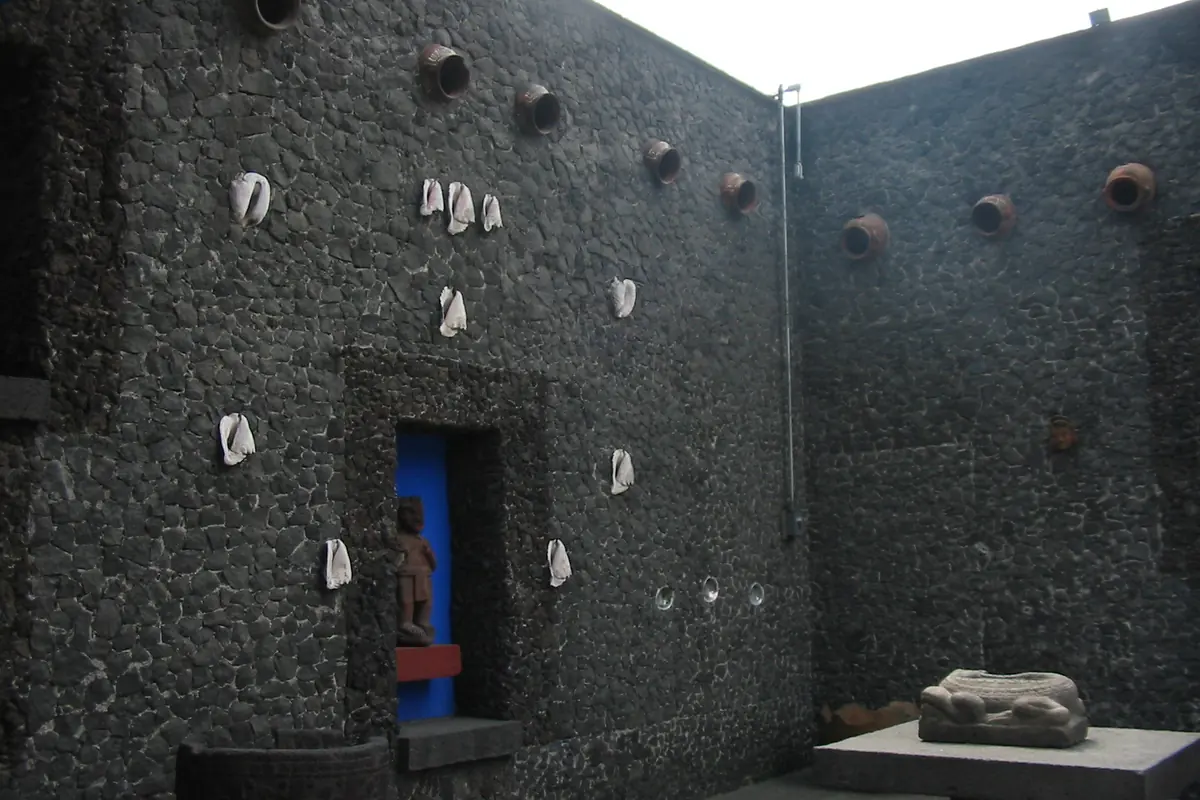
Around 1941 Rivera added a wing that faces Londres Street and closes the courtyard. It is built of local volcanic rock set with ceramic vases, with a terraced roof decorated with shells and a mirror. Kahlo's studio and bedroom moved into this wing, which is why the rooms most associated with her are upstairs and not in the older part of the house. In 1946 the architect Juan O'Gorman redid the design. The dark stone stands in sharp contrast with the blue walls, and in one corner of the courtyard a wall of black stone is studded with shells and clay pots around a small blue niche. Rivera would use the same volcanic stone on a much larger scale at Anahuacalli.
The studio
The studio is upstairs in the stone wing, a bright room where Kahlo worked in her last years. Its easel was a gift from Nelson Rockefeller, and her wheelchair stands before it, facing an unfinished portrait of Stalin. The room shows how much of her painting happened close to home and close to her own body: many of her works are self-portraits, and she painted through long periods of pain. Photographs with a phone and without flash are allowed here, for personal use.
The bedrooms
Kahlo had polio at six and in 1925 suffered a bus accident that fractured her spine and pierced her pelvis. Her mother had a mirror fitted above her bed, and during months when she could not move she began to paint herself. That bed, with its mirror, is in her bedroom today. Crutches, corsets and medicines record the operations and pain that followed for the rest of her life. Kahlo died in the house on 13 July 1954, aged 47. An urn with her ashes rests on a dresser that serves as an altar, and a pillow on the bed is embroidered with the words: do not forget me, my love.
The garden and the pyramid
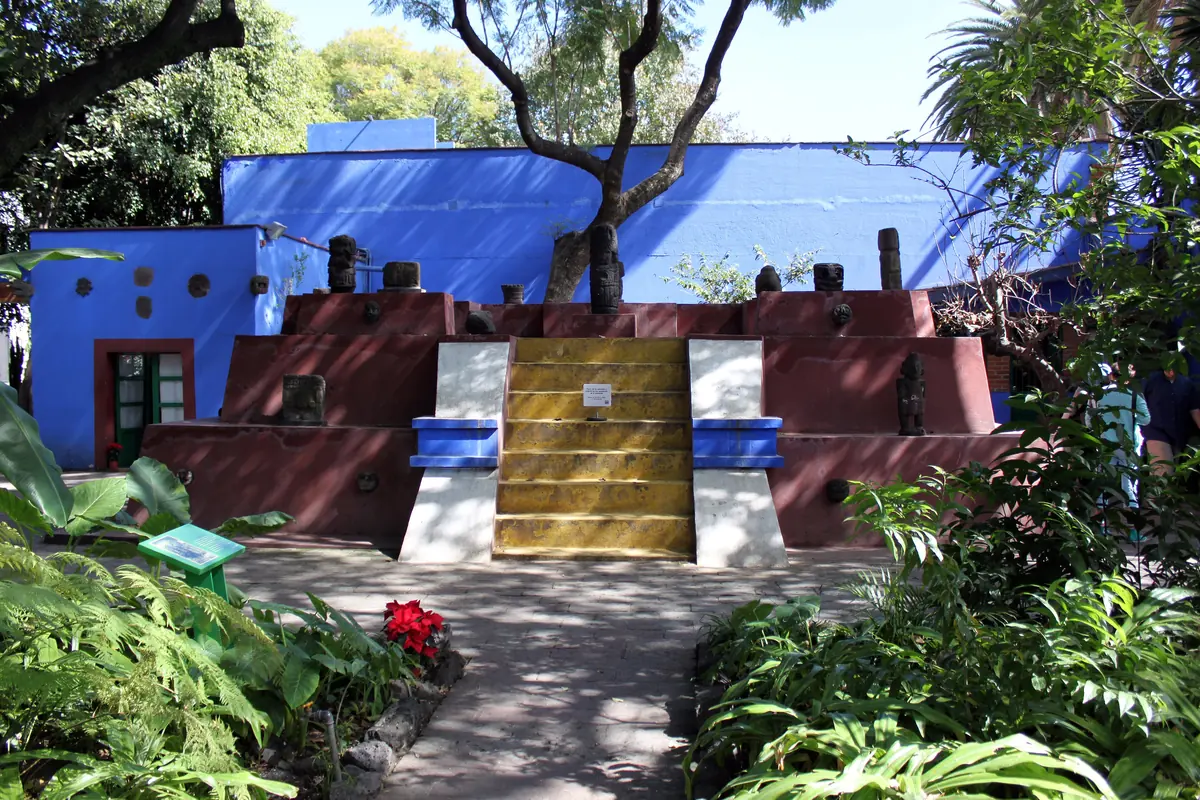
Behind the house, the garden is a calm place to end. In the 1940s the couple built a fountain, a reflection pool and a stepped pyramid to display their archaeological collection, and a stone wall divides the patio. Pre-Columbian sculptures stand among the plants, among them the maize goddess Chicomecóatl in basalt. The pyramid is painted in red, yellow and white, with pieces set on its tiers. Photography is free here, so this is the place for pictures. The museum also has a café in the grounds.
Read next: Anahuacalli with your ticket
How the house became a museum
Kahlo and Rivera wanted the house to be a museum for all Mexicans. In 1957 Rivera set up the trust that still runs it, the Fideicomiso de los Museos Diego Rivera y Frida Kahlo, with the Banco de México as trustee. The museum opened in July 1958. The poet and museographer Carlos Pellicer, a friend of the couple, planned the displays with the aim of keeping the house as it was. It reopened in 1993 after a short closure, and conservation work in 2009 and 2010 was partly funded by the German government. In 2004, bathrooms and wardrobes in the house turned out to hold thousands of documents, photographs, books, dresses, corsets and toys, the largest find in the museum's history.
Who this isn't for
If you come mainly for Frida Kahlo's famous canvases, adjust your hopes: some of her works are on show, but the house is about rooms, objects and daily life, and the paintings are a small part of what you see. Visitors with limited mobility should know that it is an old house that keeps its original architecture, even with ramps and an elevator. People who dislike crowds will find the rooms busy on most days. And anyone who wants a long, quiet look at every object may find an hour-long timed visit too short; a guided tour runs longer.
Frequently asked questions
Was Frida Kahlo born in the Casa Azul?
She said so, and she grew up in the house. The civil register records the nearby home of her maternal grandmother as her birthplace.
When did the Casa Azul become a museum?
In July 1958. Diego Rivera set up the trust that runs it in 1957.
Can I see Frida Kahlo's paintings there?
Some of her works are displayed, including her first self-portrait, but the house is mainly about her rooms, objects and daily life.
Who built the stone wing?
Diego Rivera added it around 1941, using local volcanic rock. Juan O'Gorman redid the design in 1946.
Where are Frida Kahlo's ashes?
In an urn on a dresser in her bedroom, which serves as an altar.
Sources