The neighbourhood
Coyoacán around the Casa Azul
What to see in Coyoacán before or after the Casa Azul: the two central plazas, the coyote fountain, San Juan Bautista, the market and the Trotsky house.
Choose a time at the Casa Azul ↗Quick answer
Coyoacán, about 10 km south of the Zócalo, is the old village around the Casa Azul. Before or after your visit, walk its narrow streets to the two central plazas, the coyote fountain in the Jardín Centenario, the parish church of San Juan Bautista and the Coyoacán market. The Leon Trotsky house museum is close to the Frida Kahlo Museum.
An old village inside the city
Coyoacán lies about 10 km south of the Zócalo, Mexico City's main square, and it keeps a distinct, bohemian character. Its name comes from Nahuatl and is usually translated as place of coyotes. After the conquest, Hernán Cortés lived here in 1521 and 1522, when Coyoacán served as the capital of New Spain. The historic centre has narrow cobbled streets and small plazas laid out in the colonial period, lined with single-family houses that were once mansions and country homes. The Casa Azul sits in Colonia del Carmen, within this old grid.
The two plazas
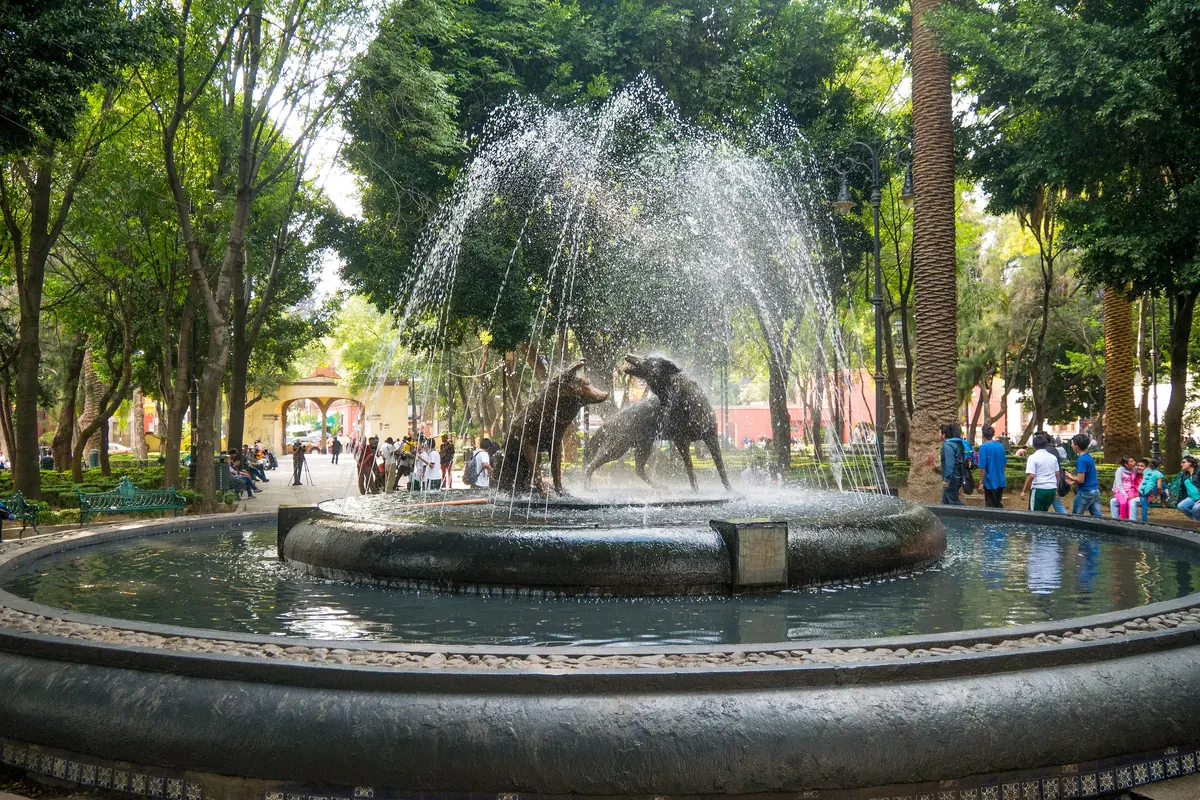
The heart of Coyoacán is a pair of plazas planted with Indian laurel trees, the Jardín Centenario and the Jardín Hidalgo, renovated in 2008 with red and black volcanic stone. The Jardín Hidalgo is the main square of the borough, with an early 20th-century kiosk given by Porfirio Díaz. In the Jardín Centenario a fountain holds a bronze sculpture of two coyotes, a nod to the borough's name, and coyotes appear again in a sculpture in front of the Casa Municipal. The plazas are the natural place to sit after the museum.
San Juan Bautista
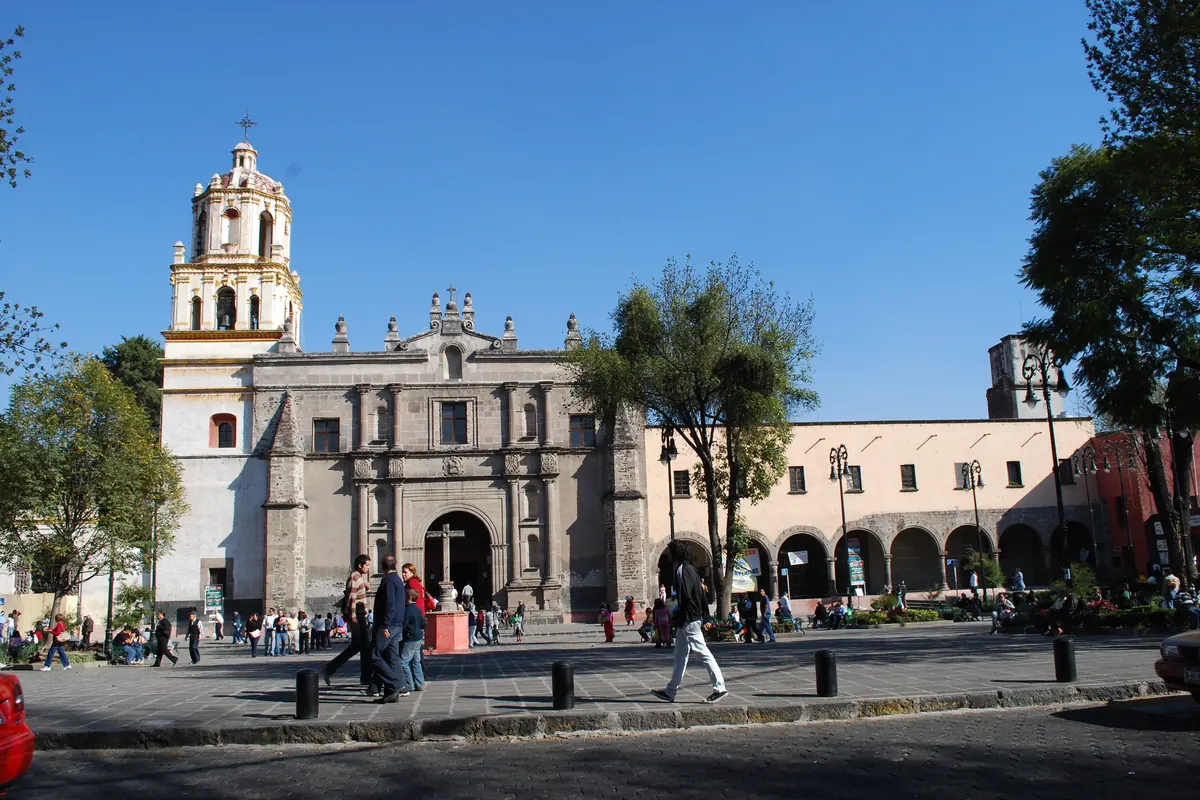
Facing the plazas, the parish church of San Juan Bautista was built between 1520 and 1552 and is one of the three oldest parish churches in Mexico City. Its stone facade and bell tower close the view across the square. It is a working church, so visit quietly and respect services. Nearby, the building long called the Casa de Cortés has housed the local government since the 18th century; despite the name, Cortés never lived there.
The market
The Coyoacán market was built in 1956 to a design by the architect Pedro Ramírez Vázquez. It is a working neighbourhood market rather than a sight laid on for visitors, and it makes an easy stop between the museum and the plazas.
The Trotsky house
Leon Trotsky and his wife Natalia Sedova lived in the Casa Azul from January 1937 to April 1939, as guests of Rivera and Kahlo, before a falling-out sent them elsewhere. The house they moved to, near the Frida Kahlo Museum, is now the Leon Trotsky House Museum. It looks like a fortress, and bullet holes from an attack in 1940 remain in its walls. For anyone interested in the politics around Kahlo and Rivera, it makes a sober counterpart to the colour of the Casa Azul.
Read next: Frida Kahlo's life in the house
Getting there
The Casa Azul is at Londres 247, on the corner of Allende, in Colonia del Carmen. Metro, Metrobús, taxis and ride-hailing all serve Coyoacán; use the city's own route planner for your starting point, and leave a margin so you reach the gate ahead of your entry slot. Once you are in Coyoacán, the old centre is best seen on foot along its cobbled streets, so wear comfortable shoes. If you also plan to visit the Anahuacalli Museum, which is included with a Casa Azul ticket, take a taxi or ride-hail for that leg.
Who this isn't for
If you have only a few hours, do not try to cover Coyoacán, the Casa Azul and Anahuacalli together: choose the house and the plazas, and come back another day for the rest. And travellers looking for the city's big avenues and towers will find Coyoacán deliberately small-scale.
Frequently asked questions
How far is Coyoacán from the centre of Mexico City?
About 10 km south of the Zócalo.
What does Coyoacán mean?
The name comes from Nahuatl and is usually translated as place of coyotes, which is why coyotes appear in the fountain in the Jardín Centenario.
Is the Trotsky house near the Casa Azul?
Yes. The Leon Trotsky House Museum is near the Frida Kahlo Museum in Coyoacán.
Sources